WORLD CHAMPIONSHIPS – BUENOS AIRES 2025
WORLD CHAMPIONSHIPS – BUENOS AIRES 2025

October 5 is the date that marked the beginning of our great Argentine adventure! For the second time this year, we had the opportunity to take part in the Taekwon-do World Championships. Since our discipline is divided among many different federations, in order to prove our sporting worth, from October 9–12 we competed in the championship organized by ITF Union.
These Championships took place on the other side of the world, in Argentina’s capital, Buenos Aires. Five of our female and male athletes with the longest experience competing at high-level events were selected for the tournament. The trip leader, guide, escort, corner man and coach was Mikołaj Kotowicz.
The seniors selected for the trip were Zofia Zapolska, Szymon Grzebyk, Dariusz Pazdan and Michał Klimek, as well as junior Stefania Kotowicz. All of them took part in formal patterns and black-belt sparring events. A total of 1,100 competitors from 15 countries took part in the Championships, mainly from both Americas. KCT was the only Polish team in this elite group.

Travel and first training sessions in Argentina
The entire trip began on Saturday, October 4, at Kraków-Balice Airport, from where our team flew to Frankfurt, changing there to a jumbo jet to São Paulo, and then taking another plane to reach Buenos Aires on Sunday. Our team settled in the very center of the capital and then, on Monday, went to train at our friendly club, Grupo Escorpio.
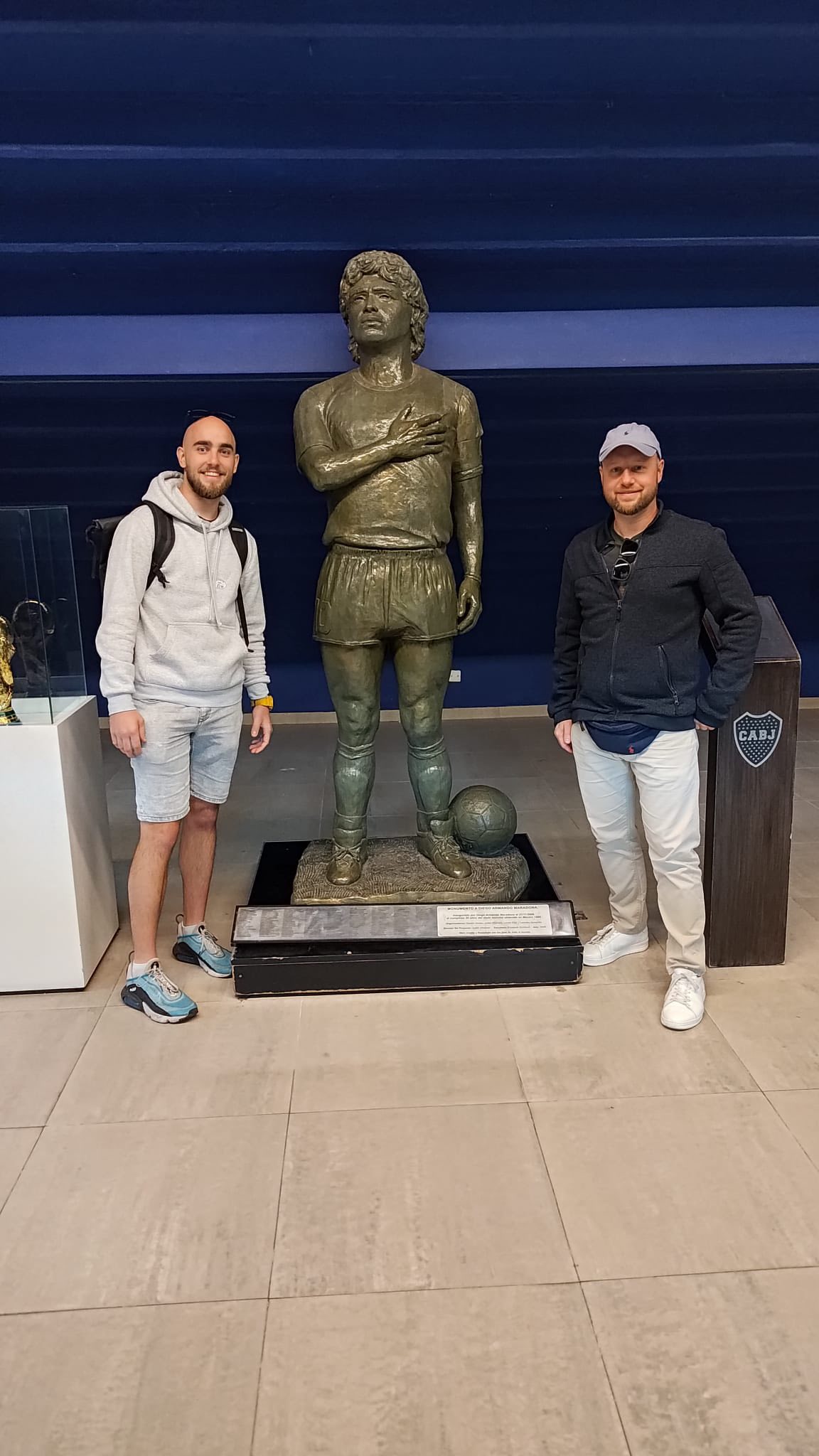
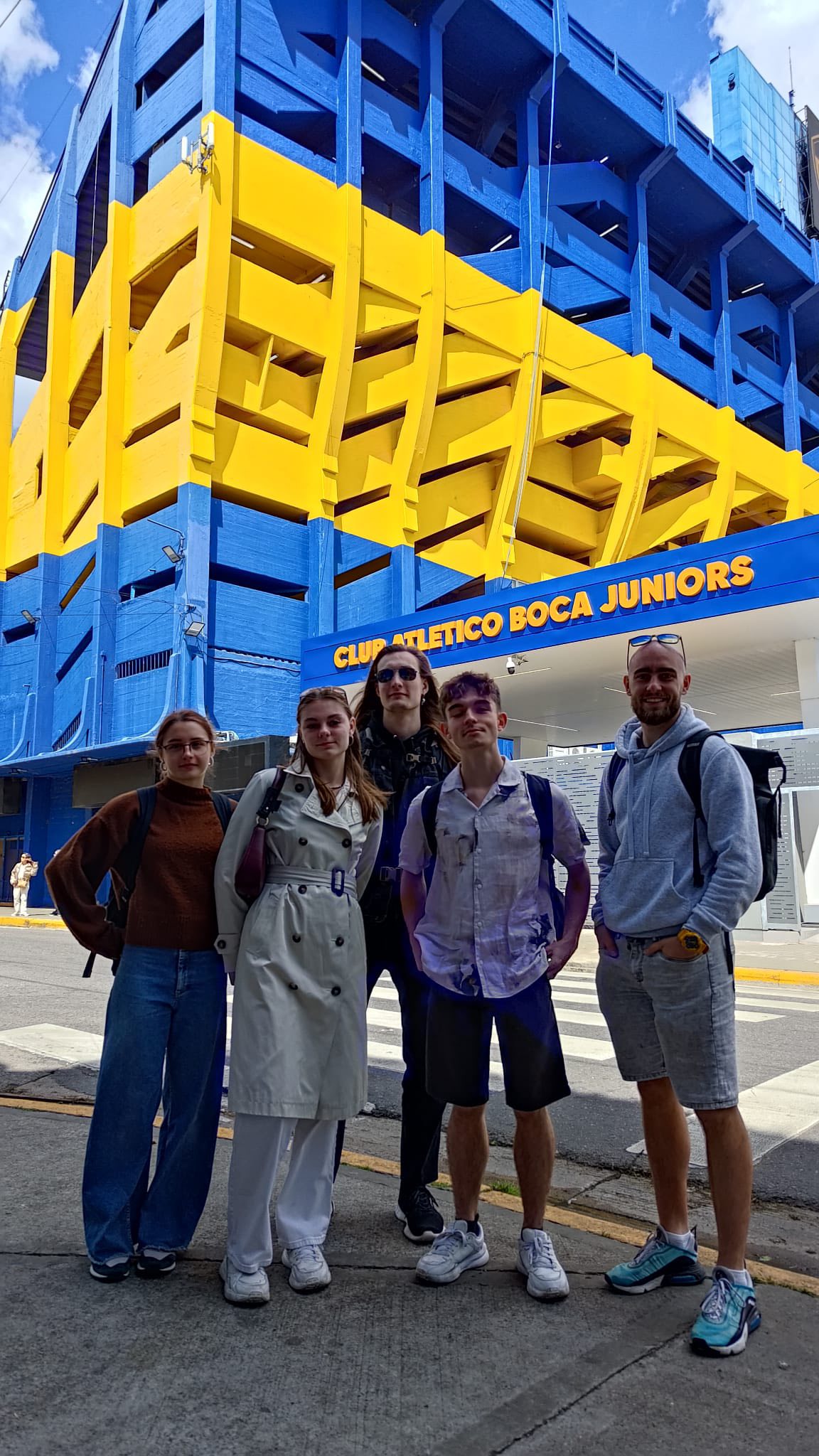
Exceptionally early, on Tuesday, we managed to register and weigh in. Thanks to this, in the following days our fighters could freely snack on empanadas. In their free time before the competition, they also managed to see a substantial part of Buenos Aires. We visited the Monserat, Puerto Moreno and colorful La Boca districts, where we entered the stadium of the legendary Boca Juniors club—the same stadium where the divine Diego Armando Maradona began his professional football career.
Competition proceedings
Thursday – formal patterns
Thursday was our first day of the World Championships. The girls were first up, competing in formal patterns. Each of them faced a field of several dozen competitors, so we knew it would not be easy. Zosia was somewhat overcome by stress and made a single mistake in each of her two performances, which cost her a place in the next round. The same happened to Stefania, who paused too long on one movement and consequently fell short of the points needed to win.
Friday – men’s patterns
On Friday, our men entered the patterns competition. Each of them delivered excellent performances, but the level of their opponents was absolutely exceptional. Of the three, only Darek Pazdan managed to get through the first round, but he was eliminated in the quarterfinals. Considering that each of them specializes more in sparring, this result in formal patterns can be considered very good.

Saturday – opening ceremony and start of sparring
On Saturday, the official opening ceremony took place. It began with representatives of all participating countries entering the rings with their flags. Then there were speeches and trophy presentations—the usual proceedings. Representatives of Ethiopia presented an interesting acrobatic martial-arts demonstration. The whole event ended with an extraordinary show: smoke, music, laser displays and drummers.
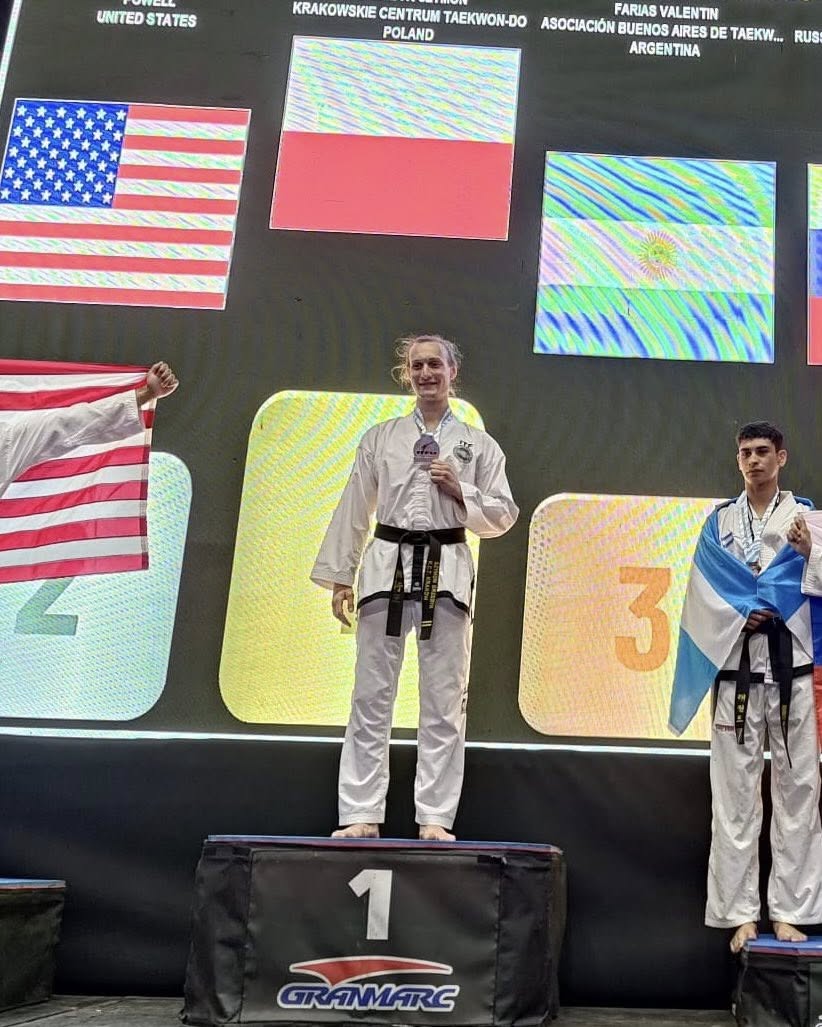
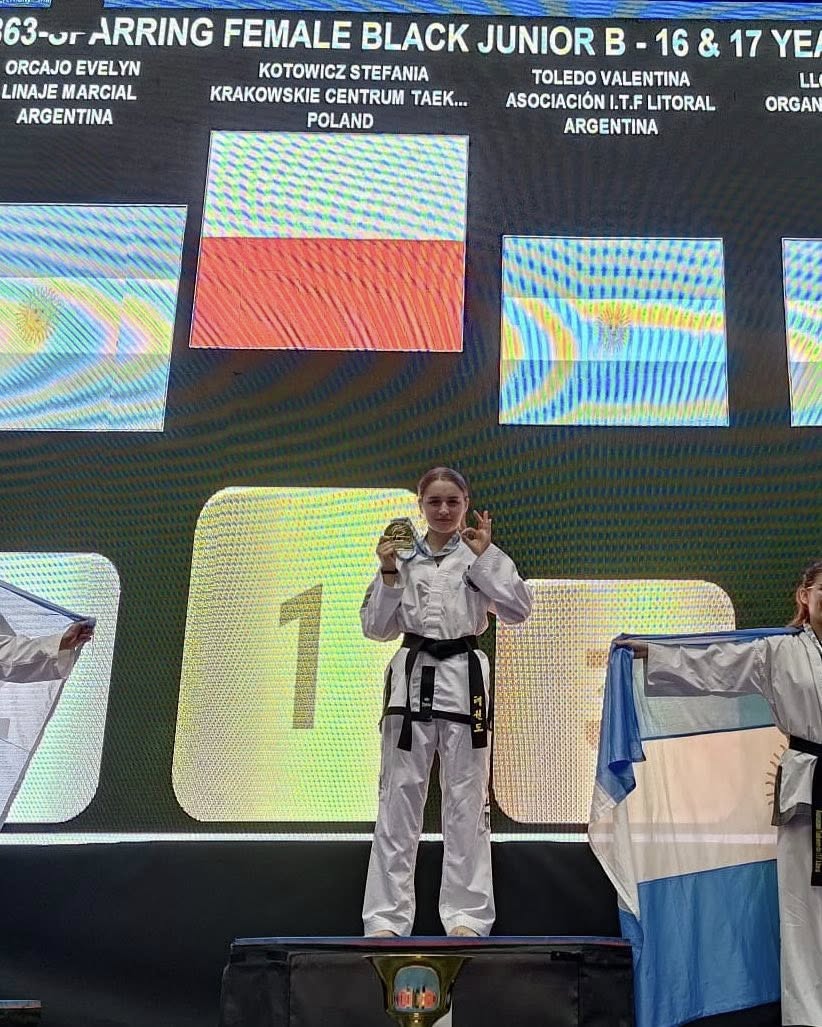
Stefania Kotowicz’s gold
At last, we got to the most important part—fights. Stefania was first up, and she was full of fire. Thanks to a fortunate draw, she went straight into the semifinal. Right at the start, in the first exchange, she broke her opponent’s nose with a yop-dollyo chagi combination. Although her opponent returned to the fight after medical attention, Stefka, colloquially speaking, “ran right over her.”
A moment later, she entered the final against another Argentinean. After what she had seen, the opponent must already have had shaky legs, because our athlete controlled the fight from beginning to end and built a several-point lead with the judges, which she maintained to the finish. In this way, after many years, KCT once again had a World Champion among the black belts.
Our athletes’ fights
Then things really got hectic. All our remaining athletes fought almost simultaneously on four rings, meaning that some of our fighters were cornered not by Coach Mikołaj, but by coaches from other countries who had been grabbed from ringside.
In his first fight, Dariusz Pazdan smoothly defeated an Argentinean. In the second, a Uruguayan tried to stand up to him. He also could not cope with Darek. After the fight, the Uruguayan side filed a protest, demanding our representative’s disqualification for allegedly kicking an opponent lying on the ground after the stop command. Ultimately, the protest was withdrawn when it turned out that the strike had been delivered so quickly that it landed before the opponent had managed to reach a horizontal position.
Unfortunately, this tense atmosphere affected his quarterfinal performance. Although Darius managed to force extra time in his fight against a Spaniard, in the end he had to concede superiority to the eventual World Runner-up.
On Saturday, Michał Klimek fought twice against very demanding opponents. First he defeated an Argentinean, and in the next bout he “thrashed” his opponent from Mexico, advancing to Sunday’s semifinal.
Both of Szymon Grzebyk’s fights ended similarly. He gave both his first opponent from Argentina and his second from Mexico such a beating that they will probably dream about it at night for a long time.
Sunday – semifinals and finals
On Sunday, the semifinals began almost simultaneously. In the first of them, Szymon fought a very close battle with a representative of Russia, winning after extra time.
Because of this, Zocha entered her semifinal without her coach. She narrowly lost the first round, and although she briefly managed to take the lead in the second, small mistakes unfortunately decided her defeat against a Chilean, who later won the entire category.
Michał Klimek faced a very awkward, defensively fighting representative of Ethiopia. Unfortunately, this tactic allowed him to gain a small advantage that Michał was unable to make up. Thus, like Zosia before him, our athlete ended the competition with a bronze medal.
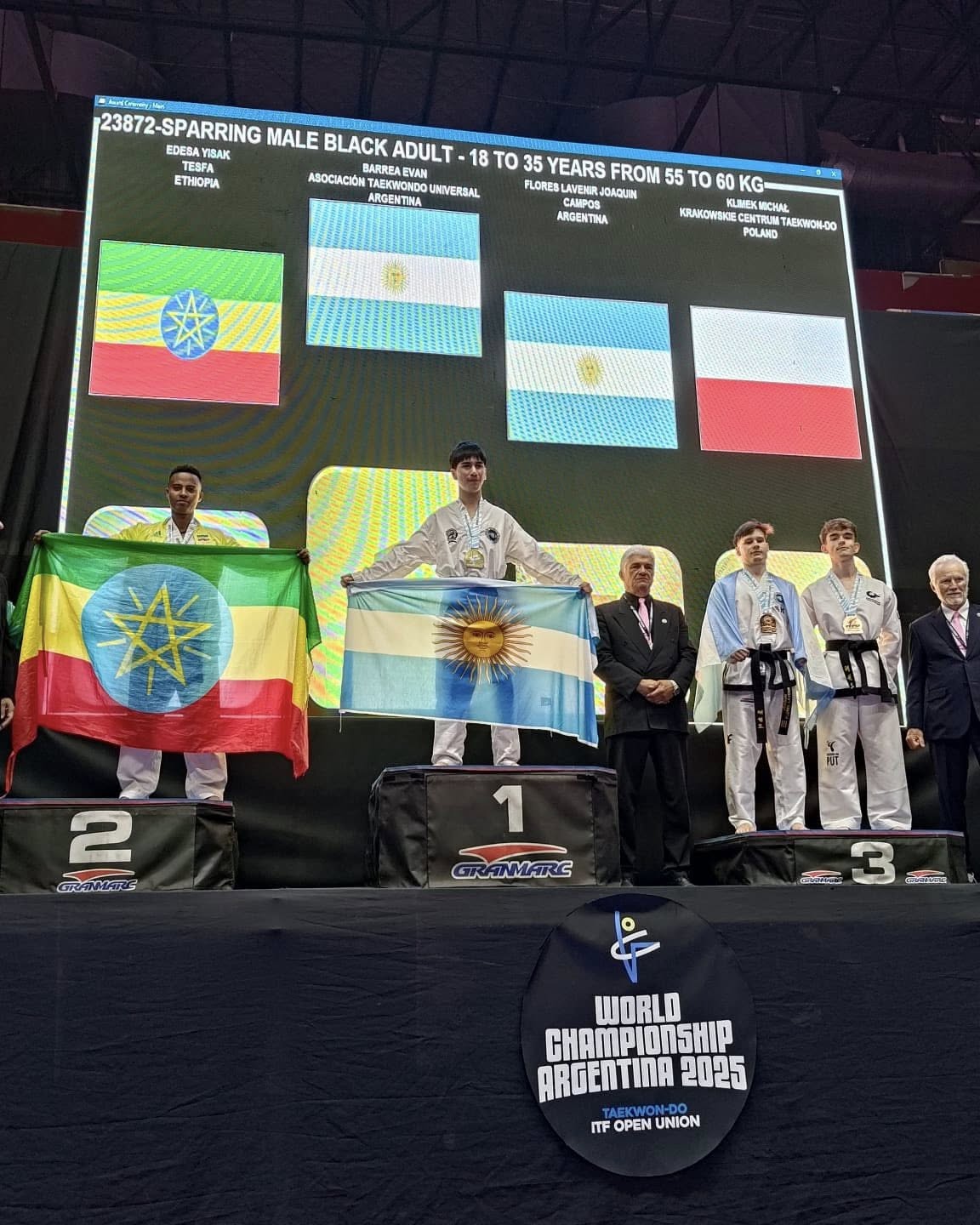
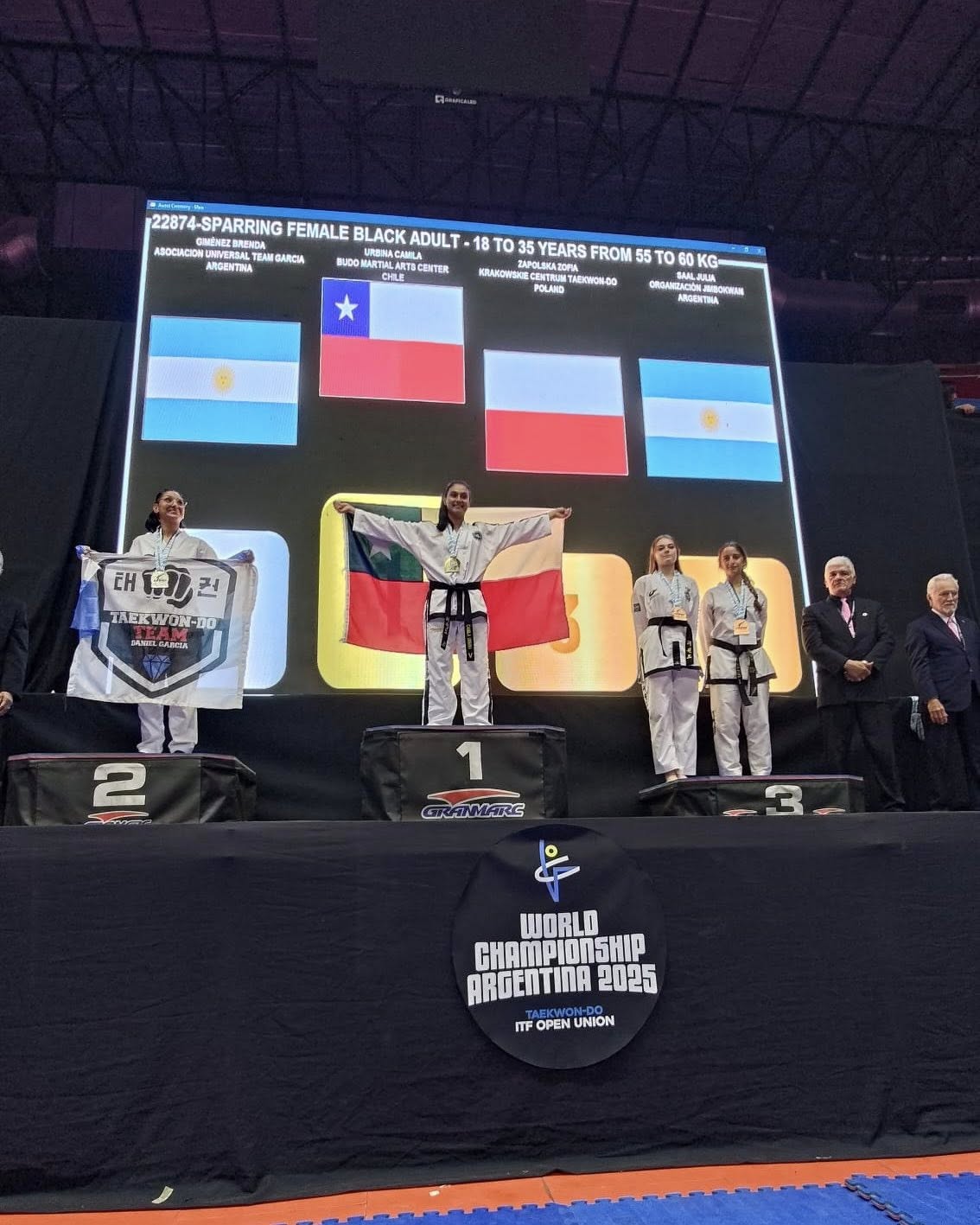
Szymon Grzebyk’s final and gold
In the final, Szymon Grzebyk faced a representative of the USA. The opponent had shown an ultra-defensive style in his previous fight, so the beginning resembled chess more than taekwon-do.
Although the American tried to surprise Szymon with unexpected changes of pace and unforeseen attacks, our athlete read his “game” excellently, countering appropriately with his legs and jumping hand techniques. This allowed him to win unanimously and claim the coveted World Champion title.
Competition summary
In summary, it must be acknowledged that the sporting level of the Championships, despite the absence of several European and Asian teams, was very high. Organizationally, everything also ran smoothly—on 8 mats, a group of several dozen judges conducted and assessed many individual and team events fairly well, including events for people with disabilities.
With 15 countries competing, our five-person team placed 9th with 2 gold and 2 bronze medals. Due to the number of participants, the hosts won the medal table.
TRAVEL THROUGH ARGENTINA
After the competition – sightseeing and training
The day after the competition, our team continued sightseeing in the city, including the Recoleta district. In the evening, coaches Mikołaj and Dariusz guest-coached a training session at Alianza Buenos Aires.
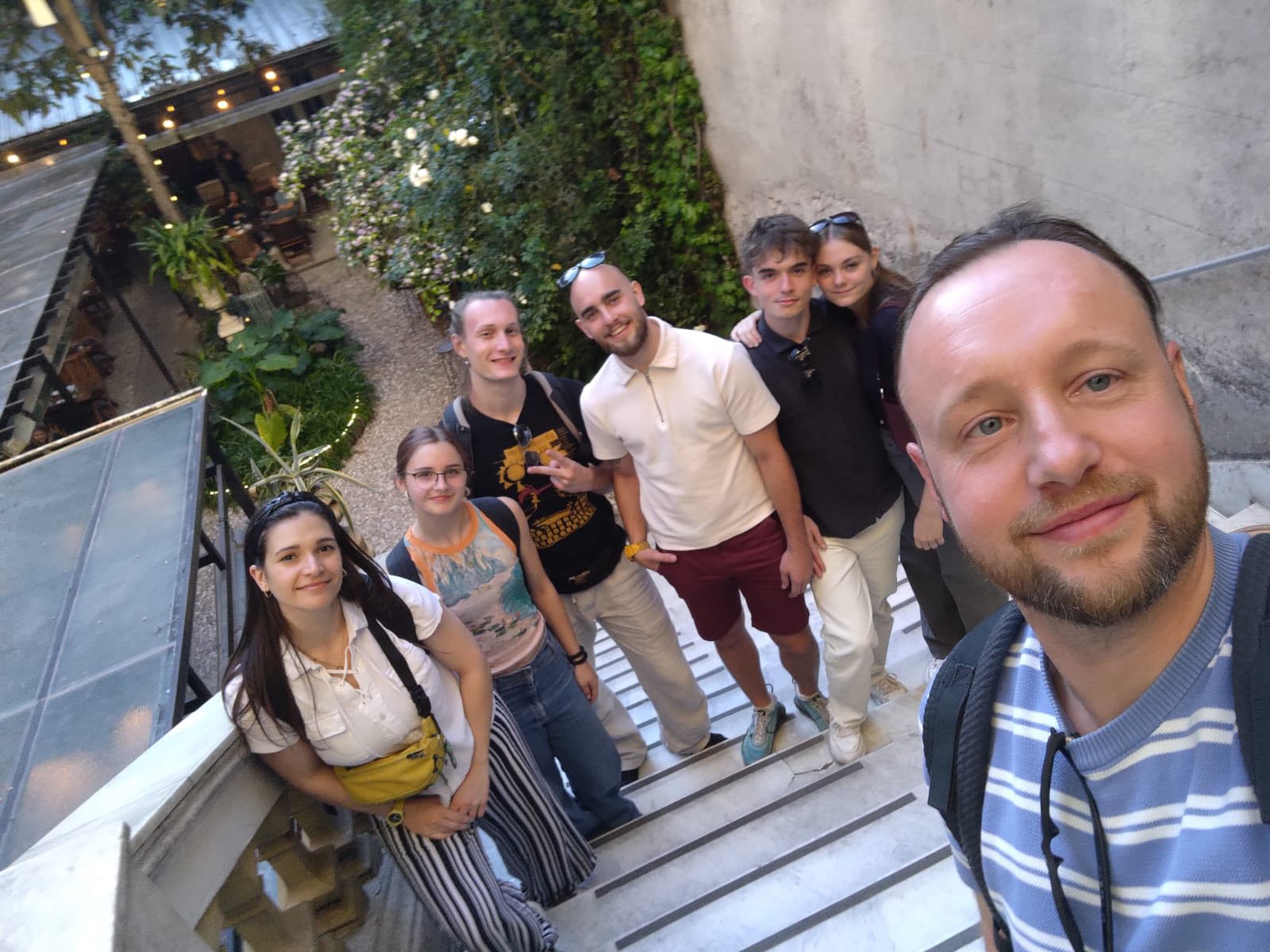
Because even the huge, 17-million-strong Buenos Aires did not offer our travelers enough experiences, they set off on another journey, even farther south. They flew to El Calafate, a city in Patagonia, in the steppe- and glacier-covered province of Santa Cruz. They spent 2 days and 2 nights there.
Patagonia – Perito Moreno Glacier
The most important day was the trip to Los Glaciares National Park. There, in the Andes, is one of the largest glaciers in the world. One of its smaller sections, Perito Moreno, with an area 1.5 times larger than Buenos Aires, descends into Lago Argentino.
The front of this glacier consists of gigantic ice cliffs extending 5 km in width, with their height above the water ranging from 40 to 70 meters. We had the opportunity to observe the calving process twice—that is, enormous pieces of ice breaking off into the water.
In addition to watching this phenomenon from observation points on the shore, we also enjoyed approaching to within 300 meters of the glacier front by catamaran.
The final days and return home
For the final days, we flew back to hot Buenos Aires. We had training sessions planned again—first at Escorpio club in Avellaneda, a city in the capital’s metropolitan area. This time there was no athletes’ weigh-in the next day, so after a hard training session we could go for pizza.
On Saturday, in turn, we went to San Isidrio, where, at the invitation of Juche club, we led a joint training session for red and black belts in the very interesting Shaolin Temple hall. The invitation included not only training but also an asado organized in our honor—a shared barbecue. Our team had the opportunity to try what Argentina is famous for: chorizo, kishka, chicken, ribs and grilled entrecôte, as well as local drinks.
On the day of departure, everyone agreed that we would rest on the plane, so before noon we visited Teatro Colon—a magnificent opera house with the best acoustics of any opera house in the world and seating for almost 3,000 spectators.
The return journey was somewhat calmer. At Ezeiza Airport in Buenos Aires, we boarded a Boeing 747, and after changing planes in Frankfurt, we arrived in Kraków in less than a day.